












.

.

.

.

.

.

.

.

.

.

.

.

.

.

.

Impact at a Glance.


01. Paper Waste

Waste-to-Treasure

Global Problem

20% of ROYO

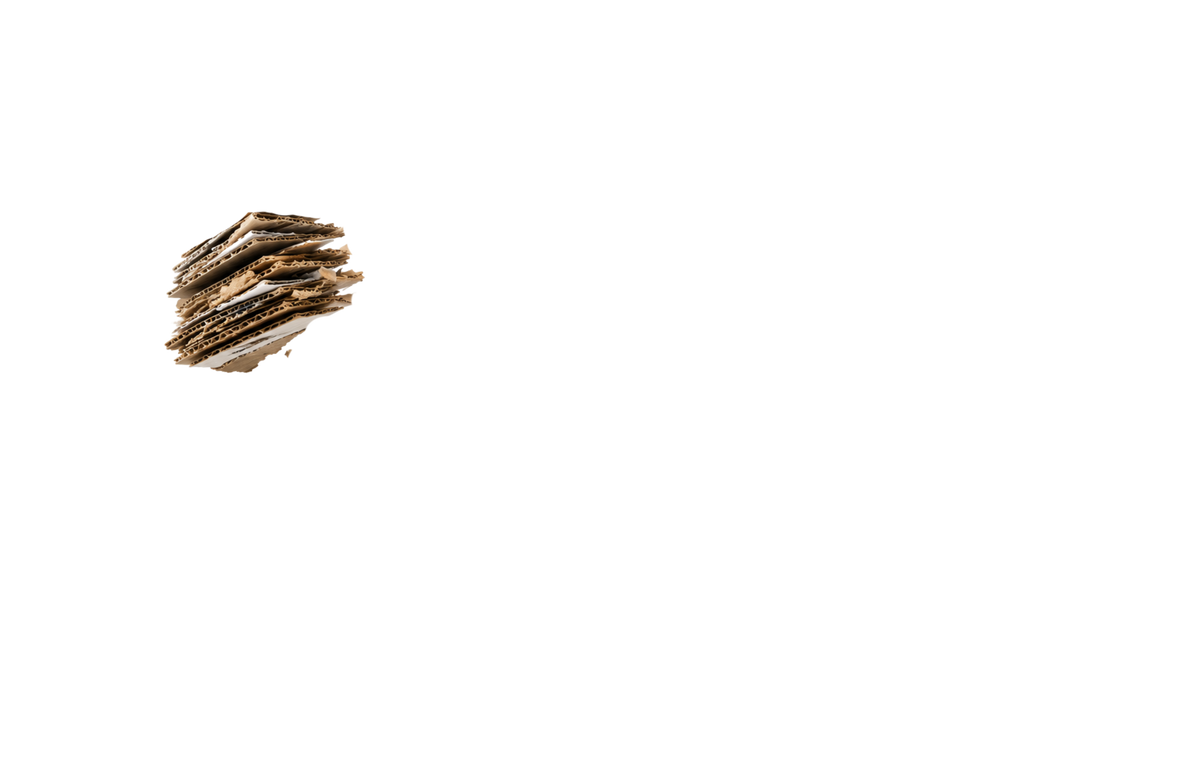
ROYO selected paper waste because:

  • Produced and discarded in large quantities
  • Rich in usable cellulose fibre
  • Commonly generated by packaging and logistics
  • Already available as an existing material resource
  • Capable of being broken down and reconstructed
  • However, not every discarded box can be used immediately. Tape, labels, coatings, food residue, moisture and mixed materials can affect whether cardboard is suitable for recovery.

Designed for a short first life, fibre inside still holds value.

The world generated approximately 2.56 billion tonnes of municipal solid waste in 2022. Without stronger action, the World Bank projects this could reach 3.86 billion tonnes by 2050, an increase of about 50%. Around one-third of global waste is currently uncollected or openly dumped.

In the World Bank’s earlier global waste-composition dataset, paper and cardboard represented approximately 17% of municipal solid waste. Applied to the 2.01 billion tonnes of waste recorded in that dataset, this was equivalent to roughly 342 million tonnes of paper and cardboard waste a year. This is an older global benchmark based on 2016 data and should be labelled accordingly rather than presented as a current estimate.

At the same time, the world continues to produce paper at enormous scale. FAO reported that global paper and paperboard production reached 401 million tonnes in 2023. Production is not the same as waste generated in that year, but it shows the volume of paper-based material continuously moving through the global economy.

ROYO’s response

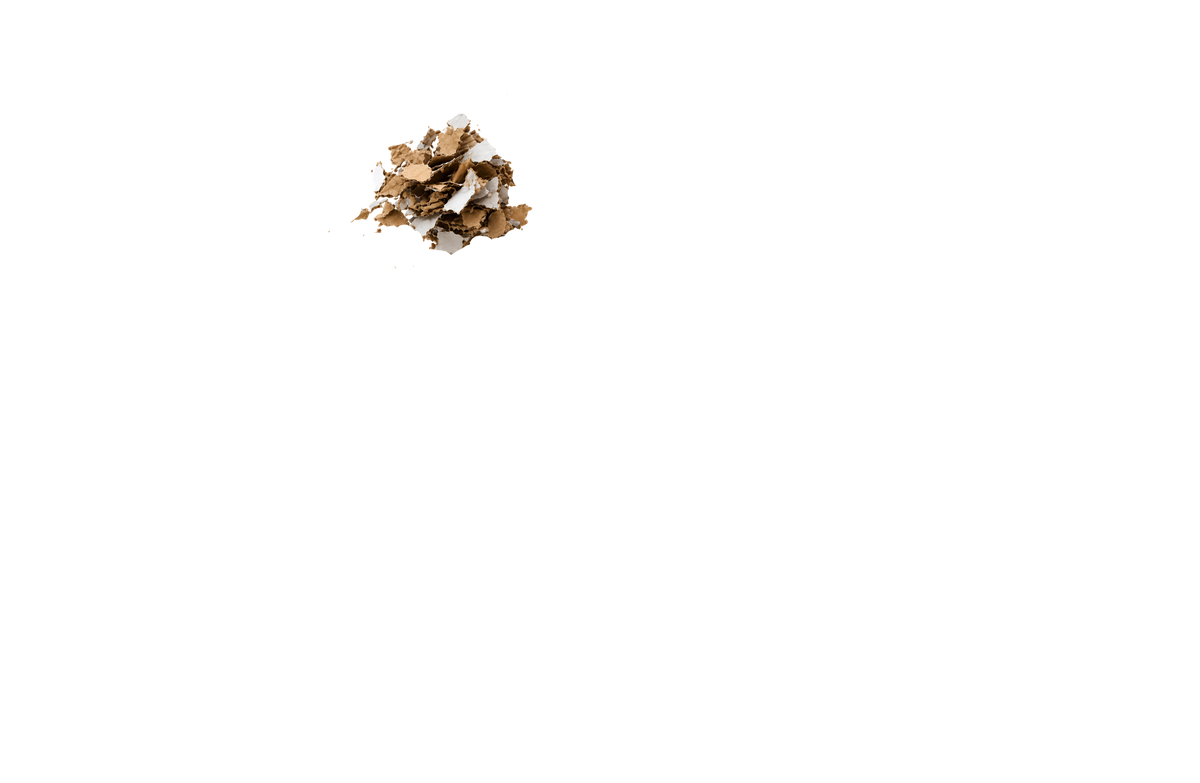
ROYO takes selected cardboard waste, breaks it down into pulp and reconstructs the recovered fibres as part of a new surface material.

The currently published ROYO composition contains:30% cardboard waste pulp

The remaining composition includes waste cotton pulp, wood pulp, water-based resin and surface-finishing components needed to create strength, flexibility and protection.

The impact is not simply that ROYO contains waste. It is that a material originally designed for packaging is given a new function in furniture, fashion, interiors and branded products.

02. Upcycling

Recycling vs Upcycling

Material Yield

Not returned to the same place. Given a new function.

Recycling usually turns a waste material back into a raw material for another production cycle. The new output may have a similar, lower or different purpose.

Upcycling goes a step further in design intent: the waste is reconstructed into something that has a new function, longer expected use or higher perceived value.

ROYO does not simply turn cardboard into another box. It restructures recovered paper fibre into a surface that can be used for furniture, fashion accessories, interiors and branded objects.

This matters because the global economy remains far from circular. UNEP reports that only about 8.6% of the global economy is circular, while global municipal waste is projected to grow from 2.1 billion tonnes in 2023 to 3.8 billion tonnes by 2050.

1 tonne of paper waste ->
1,600 m² of ROYO

Upcycling is not only about keeping waste away from disposal. It is about giving that waste a new function and greater material value.

UNEP defines upcycling as recycling that produces a material of higher quality than the original. In ROYO’s case, cardboard made for short-term packaging is reconstructed into a surface base layer for products, furniture and interiors.

ROYO’s current production estimate shows that:

1 tonne of cardboard waste

can contribute to approximately

1,600 m² of ROYO base layer

Instead of returning discarded cardboard to another short-life packaging cycle, ROYO breaks down its fibres and rebuilds them into a larger, continuous surface.

03. Momigami

About

Material Intelligence

Paper changed through repeated physical work.

Momigami means “kneaded paper.” In traditional practice, strong paper is repeatedly worked so that a flat, relatively stiff sheet becomes softer, more flexible and more fabric-like.

The Museum of Fine Arts Boston describes Momigami as paper strengthened through the use of konnyaku starch with kōzo fibres, which can increase stiffness and resistance to water before further manipulation.

Performance can come from process, not only ingredients.

Momigami demonstrates that the behaviour of paper can change through:


  • Repeated kneading

  • Compression and movement

  • Controlled wrinkling

  • Fibre realignment

  • Surface treatment

Traditional Japanese handmade washi craftsmanship was inscribed on UNESCO’s Representative List of the Intangible Cultural Heritage of Humanity in 2014, reflecting the wider cultural importance of Japanese paper knowledge. Momigami itself should not be described as the UNESCO-inscribed element.


ROYO reinterprets the material intelligence behind Momigami through contemporary fibre processing and surface engineering.

04. Oil Paper

About

The Protective Principle

Paper strengthened through surface treatment.

Traditional oil-paper practices apply protective oils to paper so it can better resist rain, moisture and wear.

Chinese oil-paper umbrella making combines paper, bamboo construction and repeated oil treatment. A Chinese government cultural account describes the tradition as having developed over more than a millennium and notes that oil-paper umbrella craftsmanship entered China’s national intangible cultural heritage list in 2008.

A fibre sheet can remain recognisably paper while becoming more resistant.

Traditional tung-oil treatment can reduce water penetration and strengthen the paper surface. Some oil-paper umbrella processes apply multiple coats, allowing each layer to dry before the next is added.

The very first version of ROYO was 100% made using oil-paper technique. As the process evolves, the oil was replaced by other safer and more sustainable coating. Yet, the original principle still preserves.

05. Animal-Free

Why Animal-Free?

The Wider Context

Material choice also carries an ethical decision.

ROYO offers an option for brands and designers seeking to avoid animal hide in selected applications.

This does not mean that every animal-free material has the same environmental performance. The value of the claim is precise:

No animal hide is used in the disclosed ROYO formulation.

Livestock systems have impacts beyond the final hide.

FAO estimated that livestock agrifood systems generated approximately 6.2 billion tonnes of CO₂ equivalent in 2015, equal to around 12% of human-caused greenhouse-gas emissions. This includes farming, feed, land-use change, transport and other supply-chain activities—not leather alone.

06. Less Virgin Feedstocks

Virgin and Recovered

Reduction Matters

Not all raw materials begin at the same point.

Virgin feedstock comes from newly extracted, cultivated or processed resources.

Recovered feedstock has already passed through at least one previous product life.

Using recovered fibre does not remove the need for every virgin ingredient, but it reduces the proportion of material that must begin from newly processed resources.

Livestock systems have impacts beyond the final hide.

UNEP reports that annual global resource use rose from about 30 billion tonnes in 1970 to 106 billion tonnes, while extraction and processing account for more than 60% of planet-warming emissions. Under current trends, resource extraction could increase another 60% between 2020 and 2060.

ROYO's 20% of composition comes from recovered waste substrates, reducing the usage of virgin materials.

07. Biobased Fabric

It Matters

ROYO's Fibre System

Fibre markets remain heavily dependent on fossil-based synthetics.

Textile Exchange reports that polyester represented approximately 59% of global fibre production in 2024, and around 88% of that polyester was fossil-based.

Most of the disclosed formulation is fibre-based.

You could choose option to have backing fabric that is highly biobased, such as bamboo-based, cotton-based or recycled fabrics.

08. FSC Certified

Global Certification

Certification

Responsible sourcing must be followed through the supply chain.

FSC operates as an international traceability system.

As of July 2026, FSC reported approximately:176.5 million hectaresof FSC-certified forest. 69,960 Chain of Custody certificatesglobally.

ROYO’s paper-based layer is produced by an FSC-certified OEM.

ROYO works with OEM to manufacture the paper-based component of the material.

The manufacturer holds FSC Chain of Custody certification covering the tracking of wood-based materials and product categories including paper, paperboard, corrugated paper and other pulp-and-paper products.

09. Testing

Why We Test

Current Results

A material that fails early creates another replacement problem.

Abrasion: What happens after repeated rubbing?


Flexing: What happens after repeated bending?


Tensile performance: What happens when the material is pulled?


Water spotting: Does brief water exposure visibly change it?

Tested evidence from specific ROYO variants.

Martindale abrasion: >40,000 cycles

Bally flexing: >80,000 cycles

Water spotting: Grade 5

Colour fastness to light: Grade 3–4

Elongation ranges: 15–30% and 20–30%

10. CO₂ Emission

Material Comparison

The material matters — but so does how we measure it.

Different surface materials can carry very different carbon footprints.

One UNIDO review cites an average of approximately 110 kg CO₂e/m² for bovine leather when cattle farming is included, while an artificial leather example was approximately 15.8 kg CO₂e/m². However, the same report shows that bovine leather estimates can range from 35–320 kg CO₂e/m², depending on how emissions are allocated and where the lifecycle assessment begins.

Studies of newer bio-based alternatives have also reported substantially lower footprints in specific cases, but these materials differ greatly in ingredients, production methods, performance and system boundaries. For example, a peer-reviewed LCA of MycoWorks’ mycelium-based Reishi material found substantially lower greenhouse-gas impacts than the bovine and synthetic leather benchmarks examined in that study.Firstly, bovine leather example, including cattle farming, at 110 kg CO₂e/m². Secondly, artificial leather example reported in the same UNIDO review, at 15.8 kg CO₂e/m². Thirdly, plant-based/bio-based/upcycled material at 0.8-8.8 kg CO₂e/m².

11. Impact Partnership

Why Partnership Matters

A Growing Impact Ecosystem

No material creates impact alone.

UNEP recognises industrial symbiosis as a system in which the waste of one company becomes a valuable raw material for another.

The environmental idea is simple: one organisation’s unwanted output becomes another organisation’s useful input.

No material creates impact alone.

ROYO has grown through collaborations and support across universities, innovation platforms, industry bodies and impact communities, including NUS Enterprise, NUS GRIP, BLOCK71, Nanyang Polytechnic, HKUST, HKUST–Sino One Million Dollar Entrepreneurship Competition, Singapore Fashion Council, Vogue x BMW Innovation Prize, UNDP, Young Social Entrepreneurs, Social Impact Catalyst, Youth Co:Lab, Singapore Furniture Industries Council, HKTDC Start-up Express, and The Mills Fabrica ecosystem. Together, these partners have helped ROYO move from material experimentation to product development, industry validation, market access and wider impact.

12. Limits

What Remains Unresolved

Environmental progress is not the same as perfection.

ROYO is currently:

  • Not 100% waste
  • Not free from synthetic polymers
  • Dependent on backing, adhesive and product design at end of life
  • Bio-based content also does not automatically establish biodegradability or compostability.